
A native web browser for Atari
Why take a taxi, when you can fly?
HighWire renders the modern web — real HTML and CSS, flexbox and grid — and reaches HTTPS sites through Mbed TLS, on TOS, FreeMiNT and MagiC. And it does it with the speed the platform is loved for.
Download Beta0.5.0 Beta 4 · for 68000 and up, and ColdFire
News
A quick release, with 68000 and ColdFire builds
This is a quick release with various bug fixes. It is the first release with 68000 and ColdFire support, and those builds have not been fully tested yet. The 68000 build uses software floating point; the 68020–60 and ColdFire builds use the hardware FPU. NanoSVG, which draws SVG images, works in floating point, so SVG is slowest on the 68000. A 68000 build without SSL is also included, for local pages and for HTTP proxies such as WebOne.
New in this release: Copy and Paste for text, animated GIFs, an optional
screen buffer, much more complete flexbox and grid, line-height,
position: fixed, viewport units, styled buttons and text
fields, live :focus styles, resumable downloads and run-time
switches for SVG, WebP, HTTPS, GIF animation and the screen buffer.
The next full release will be HighWire 1.0, to avoid problems with another project.
HighWire returns
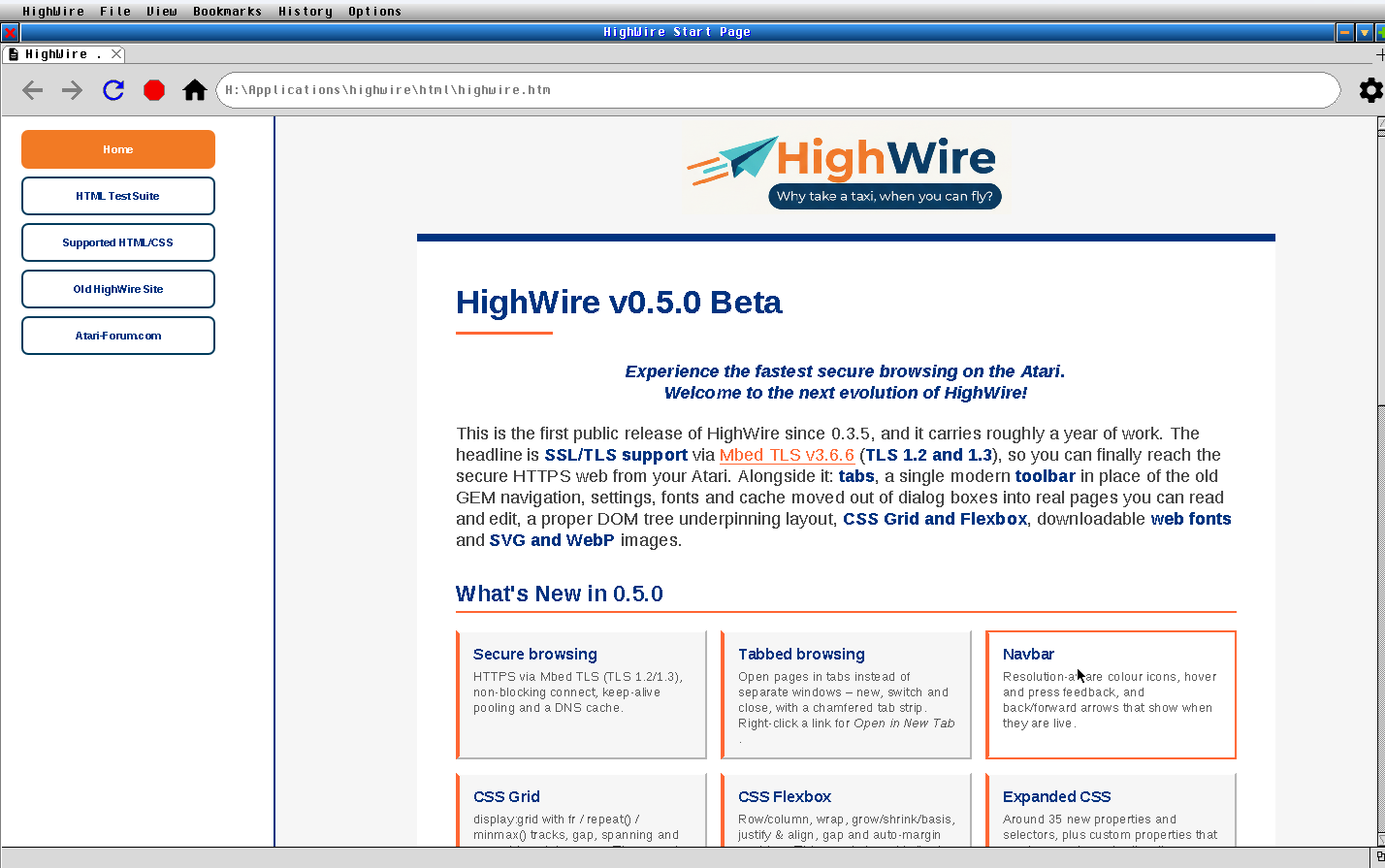
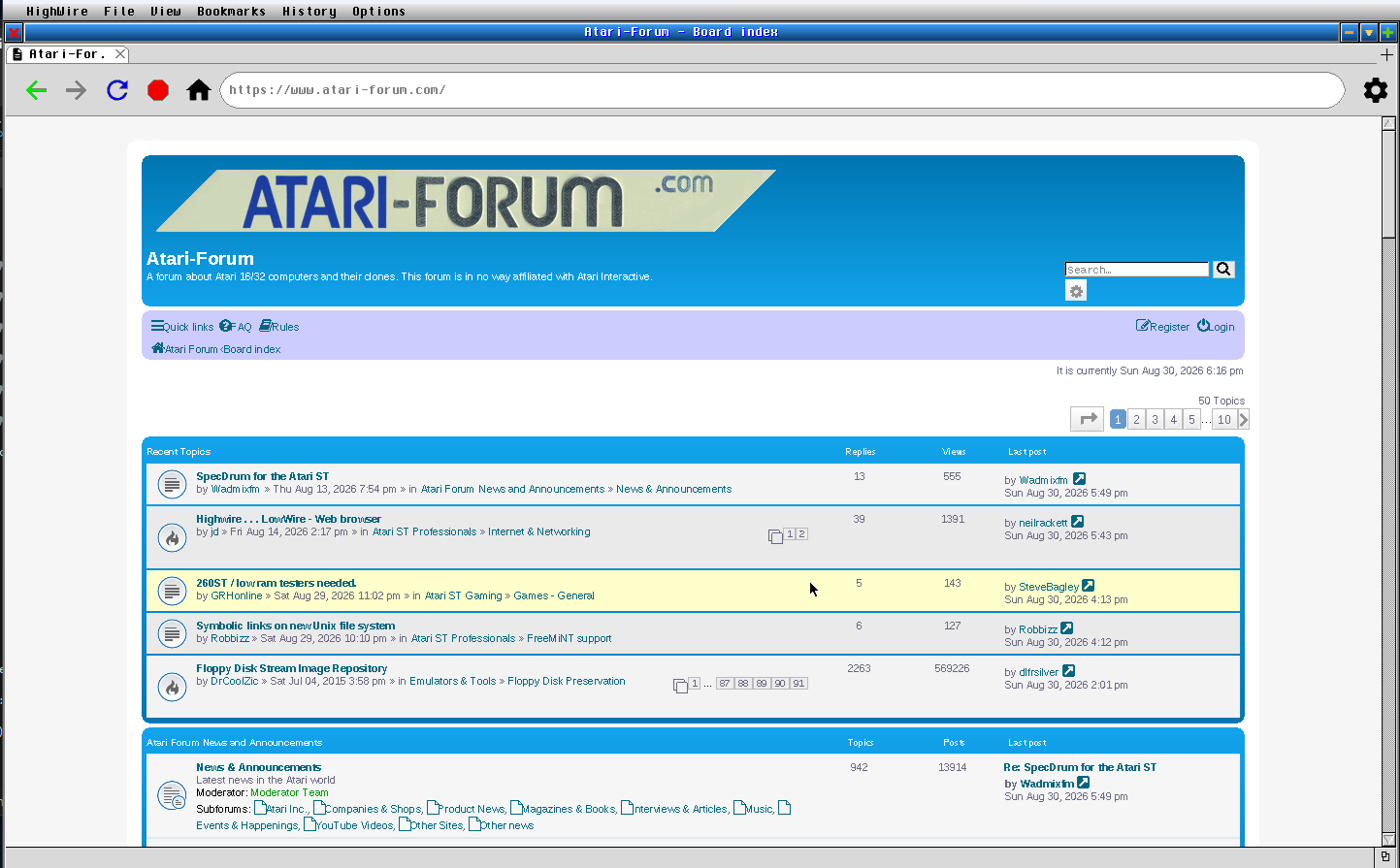
This is the first HighWire in a very long time, and it carries roughly a year of work. The headline is SSL/TLS support through Mbed TLS (TLS 1.2 and 1.3), so you can finally reach the secure HTTPS web from your Atari. Alongside it: tabbed browsing, a single modern toolbar in place of the old GEM navigation, settings, fonts and cache moved out of dialog boxes into real pages you can read and edit, a proper DOM tree underpinning layout, CSS Grid and Flexbox, downloadable web fonts, and SVG and WebP images.
What it is
The modern web, natively
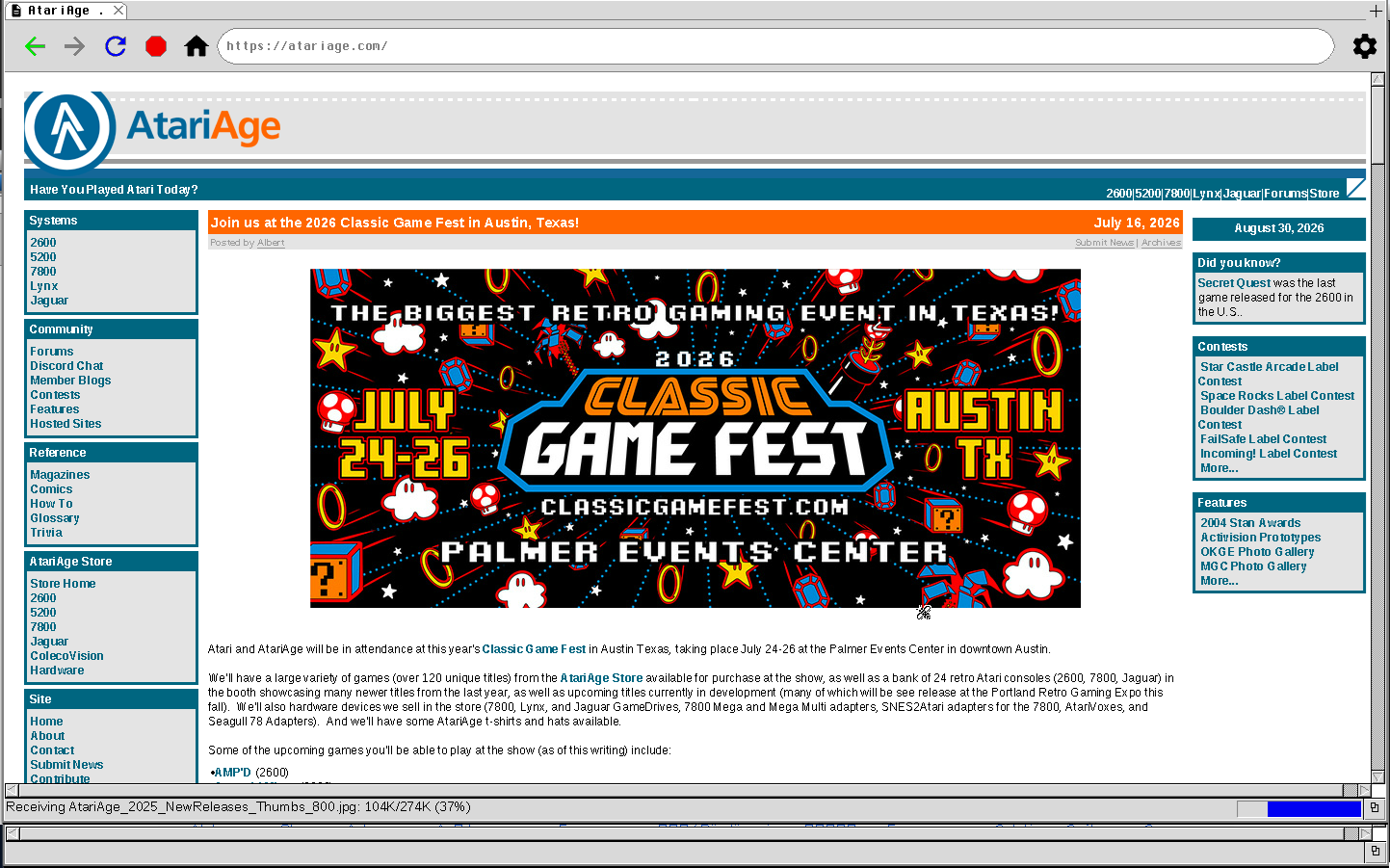
HTML and CSS rendered on the metal — including flexbox, grid, custom properties and web fonts — not a stripped-down subset.
Secure by default
HTTPS through Mbed TLS, with certificate verification. TLS session resumption means repeat visits reconnect fast.
Built for the platform
Tabbed browsing, GEM chrome, in-app settings. Speaks MiNT-net, STiK and STinG through loadable network modules.
Fast where it counts
Speed is what HighWire is loved for — rendering and layout are tuned for classic hardware, not bolted on after.
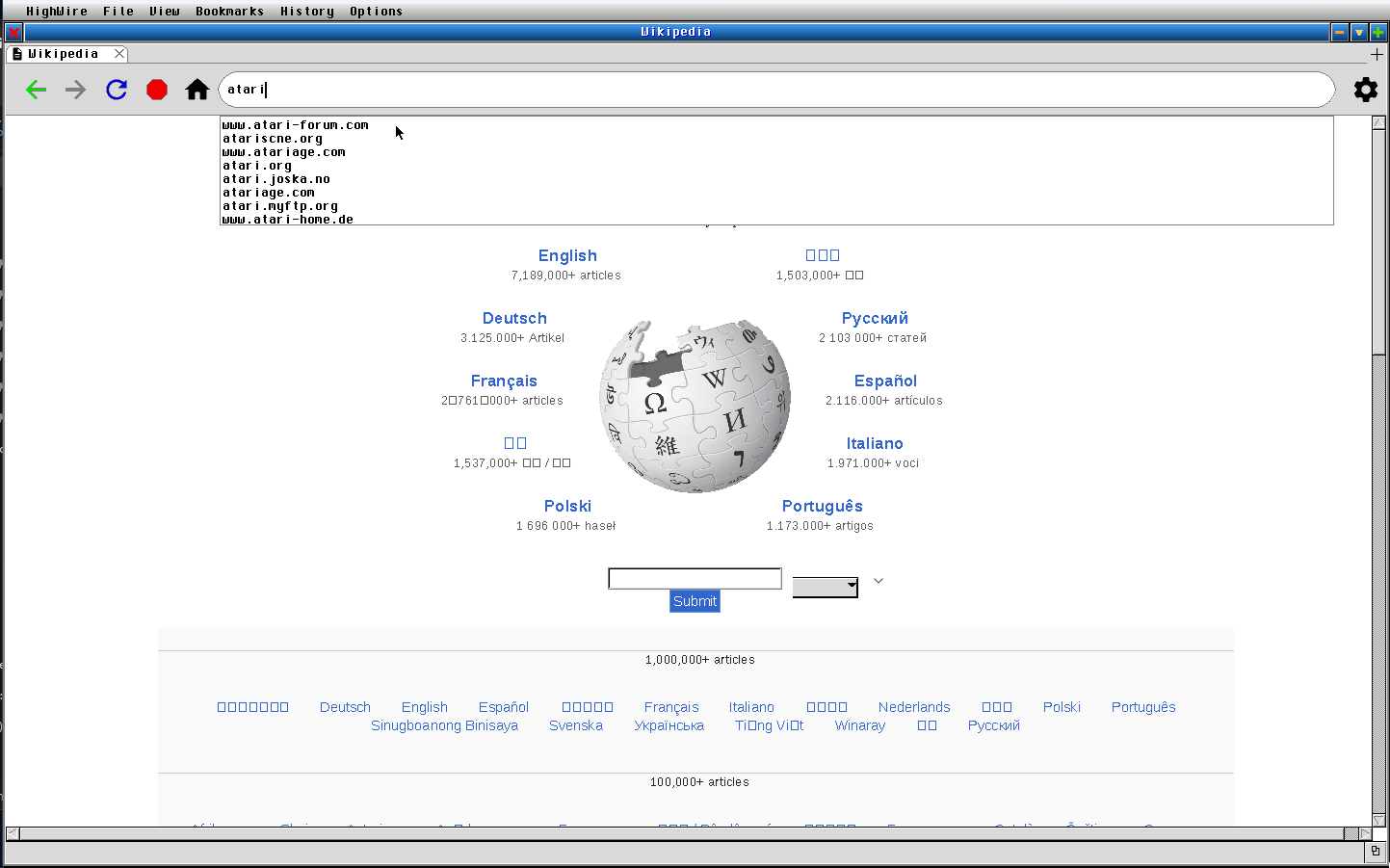
Screenshots
Click any shot to open it full size.
Getting started
1.Unzip the archive into a folder on your
Atari, keeping cacert.pem next to hw_30-60.app
— it is what verifies HTTPS sites.
2.Launch hw_30-60.app. The start
page opens in the first tab.
3.Type an address, or middle- or right-click a link for Open in New Tab. Tabs open, switch and close along the toolbar.
4.Settings live on ordinary pages: open
about:settings, about:fonts and
about:cache from the address bar or the gear icon.
5.Hit a rendering or connection problem? Add
LOG_SYNC = 1 to highwire.cfg, reproduce it, and send
the HIGHWIRE.LOG with the page address — it makes a report
far more useful.
About
HighWire is built for a platform nobody ships binaries for any more, against libraries that mostly assume a little-endian machine with a modern libc — several of them need patching before they work on a 68k at all. The HighWire-Browser organisation keeps everything needed to build the browser in one place, at the versions it was built against, so it can be rebuilt without rediscovering which libpng we used or why AES-GCM failed on big-endian.
HighWire is the work of The HighWire Project. The engine — parser, scanner, renderer, scheduler and layout — and the network overlay modules are substantially the work of Ralph ("AltF4") and Dan ("Baldrick"), built on the original Project HighWire source release by Robert Goldsmith.
Open source
HighWire's TLS and SVG libraries needed 68k / big-endian patches to work at all, and those forks are public — the mbedTLS handshake fixes and the nanosvg rasteriser fixes. The forks, the bugs we fixed, and how to build →
Download
HighWire 0.5.0 Beta 4 — builds for 68020–60, 68000 (no FPU needed), 68000 without SSL, and ColdFire V4e.
CPU 68030 or faster; a 68060 is strongly suggested. A slower 68000 build (no FPU needed) and a ColdFire build are included.
Graphics A Speedo-capable GDOS — SpeedoGDOS, NVDI 3+, or fVDI.
Network A MiNT-net or STiK/STinG stack (modules included).
Memory Plenty of free ST and TT RAM — modern pages are large.
JavaScript is not supported in this release; some modern, script-heavy sites may not display in full.
GitHub only serves downloads over https. A HighWire without SSL
(hw_00ns.app) cannot fetch this file itself: use a proxy such as WebOne, or copy it over from another machine.